Two days in Lisbon is enough to see the old hilltop districts on the first day and the riverside monuments of Belém on the second. This plan keeps each day in one part of the city, so you spend your time walking and looking instead of crossing town. Lisbon is steep, so wear comfortable shoes with good grip, and check opening hours on each site’s official page before you go, as they change with the seasons.
Table Of Content
Before You Go: A Few Practical Points
Plan the Belém day for any day except Monday, because the Jerónimos Monastery is closed on Mondays. It also closes on a few public holidays, including 1 January, Easter Sunday, 1 May, 13 June and 25 December.
Public transport in Lisbon is run largely by Carris (trams and buses) and the city metro. Buy a rechargeable transport card at a metro station rather than paying on board, and check current fares on the operators’ websites.
| Morning | Afternoon | Evening | |
|---|---|---|---|
| Day 1 | Tram 28 to Graça, Senhora do Monte viewpoint, São Jorge Castle | Alfama, Santa Luzia viewpoint, Lisbon Cathedral | Baixa, Praça do Comércio, fado in Alfama |
| Day 2 | Tram 15 to Belém, Jerónimos Monastery, custard tarts | Monument to the Discoveries, Belém Tower | LX Factory in Alcântara |
Day 1 Morning: Tram 28 and the Castle
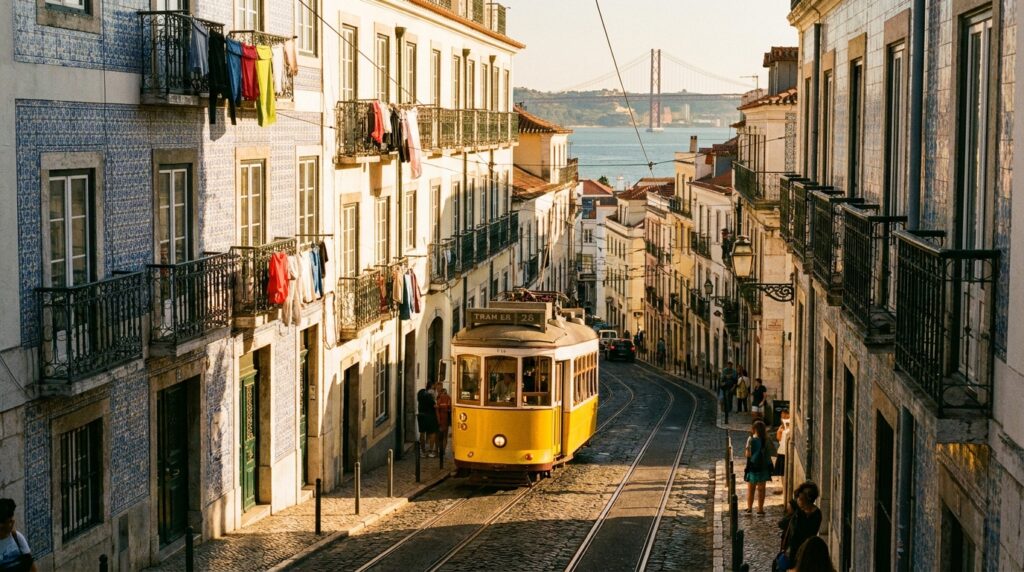
Start early with a ride on tram 28, before the crowds build up. The route runs about 7 km between Martim Moniz and Prazeres, near Campo de Ourique, passing through Graça, Alfama, Baixa and Estrela. The small yellow trams on this line keep much of their 1930s look, with wooden interiors, and they are still used because the curves and slopes are too tight for modern trams. From mid-morning to evening the tram is usually packed, so an early ride is far more pleasant. Carris sometimes shortens or diverts the line for roadworks, so check its service updates on the day.
Get off in Graça and walk to the Miradouro da Senhora do Monte, the highest viewpoint in the city. From here you look over red roofs, the castle and the Tagus river.
Then walk downhill to the Castelo de São Jorge. The castle was held by the Moors until 1147, when Lisbon fell to Afonso Henriques, the first king of Portugal. Portuguese kings lived here until Manuel I built a new palace by the river. Today you can walk the walls and towers, and the gardens inside are shaded and calm. The castle opens at 9am every day except a handful of holidays, with later closing times from March to October.
Day 1 Afternoon: Alfama and the Cathedral
Spend the afternoon wandering down through Alfama, Lisbon’s oldest district, a maze of stairways and small squares below the castle. There is no need for a fixed route. Head downhill and you will reach the river.
Stop at the Miradouro de Santa Luzia, a terrace with a pergola and blue and white azulejo tile panels. One panel shows Praça do Comércio before the 1755 earthquake, and another shows the siege of the castle in 1147. Tram 28 also stops right outside.
Continue down to Lisbon Cathedral, known locally as the Sé. It is the oldest church in the city, begun in 1147 on the site of the main mosque after the city was taken. It has been repaired and changed many times after earthquakes, so its style is a mix, but the heavy Romanesque front still looks like a fortress.
Day 1 Evening: Baixa and Fado
End the day in Baixa, the flat grid of streets between the hills, and at Praça do Comércio, the large square on the river. Both were rebuilt after the earthquake, tsunami and fires of 1 November 1755 destroyed much of Lisbon. The Marquis of Pombal, chief minister to King José I, led the rebuilding, and the new streets were laid out on a straight grid that still shapes the area.
The triumphal arch on Rua Augusta opens onto the square. It was finished in 1873, and a paid ticket takes you up to a small rooftop viewpoint over the square and the river.
For dinner, go back up to Alfama or across to Bairro Alto for fado, the city’s traditional song style, often about longing, the sea and hard lives. UNESCO added fado to its list of the Intangible Cultural Heritage of Humanity in 2011. Many small restaurants have live fado in the evening; book ahead and expect the room to go quiet during each song.
At a fado house, stay silent while the fadista sings. Order and chat between songs, not during them.
Day 2 Morning: Belém and the Monastery
Take tram 15 from Praça da Figueira or Praça do Comércio along the river to Belém, a ride of roughly 30 to 40 minutes. Get off at the Mosteiro Jerónimos stop.
The Jerónimos Monastery is the reason many visitors come to Belém. Building began in 1502, and the church holds the tombs of the explorer Vasco da Gama and the poet Luís de Camões. Together with Belém Tower, it was added to the UNESCO World Heritage List in 1983. The church is free to enter; the cloister needs a ticket, and queues can be long, so arrive close to opening time or book online.
Just along the street is Pastéis de Belém, which has baked custard tarts to a recipe from the monastery since 1837. The bakery says the recipe is still made by hand in a closed room known only to its master pastry cooks. Eat them warm, with cinnamon and icing sugar on top.
Day 2 Afternoon: The Riverfront Monuments
Walk across the gardens to the river and the Padrão dos Descobrimentos, the Monument to the Discoveries. It is shaped like the prow of a ship, with Henry the Navigator at the front and figures from the age of exploration lined up behind him. A temporary version was built for an exhibition in 1940, and the permanent stone monument was finished in 1960 for the 500th anniversary of Henry’s death.
A short walk west brings you to Belém Tower, built between about 1514 and 1519 to guard the entrance to the harbour. After a year of restoration work, the tower reopened to visitors on 27 May 2026. Inside, narrow stairs lead up to terraces with views along the river.
Day 2 Evening: LX Factory
On the way back toward the centre, stop at LX Factory in Alcântara, near the Calvário stop on tram 15. It sits in a former industrial complex where a textile company opened in 1846. The buildings stood empty for years before reopening in 2008 as a creative space with shops, bookshops, studios and restaurants.
It is a relaxed place for dinner after a day of monuments. From there, tram 15 or a short taxi ride takes you back to Cais do Sodré and the centre.