The safest way to carry money and documents abroad is to spread them out, so that losing one bag or one wallet never leaves you with nothing. Add a few habits at cash machines and card terminals, and know what to do if something goes missing. None of this needs special gear. It is mostly common sense, set up before you leave your room each morning.
Table Of Content
- Split Your Money and Cards Into Two or Three Places
- Use Cash Machines With Care
- Pay in the Local Currency
- Carry Your Passport Only When You Need It
- Make Yourself a Harder Target in Crowds
- Protect Your Phone and Digital Copies
- What to Do If Your Cards Are Lost or Stolen
- What to Do If Your Passport Goes Missing
Split Your Money and Cards Into Two or Three Places
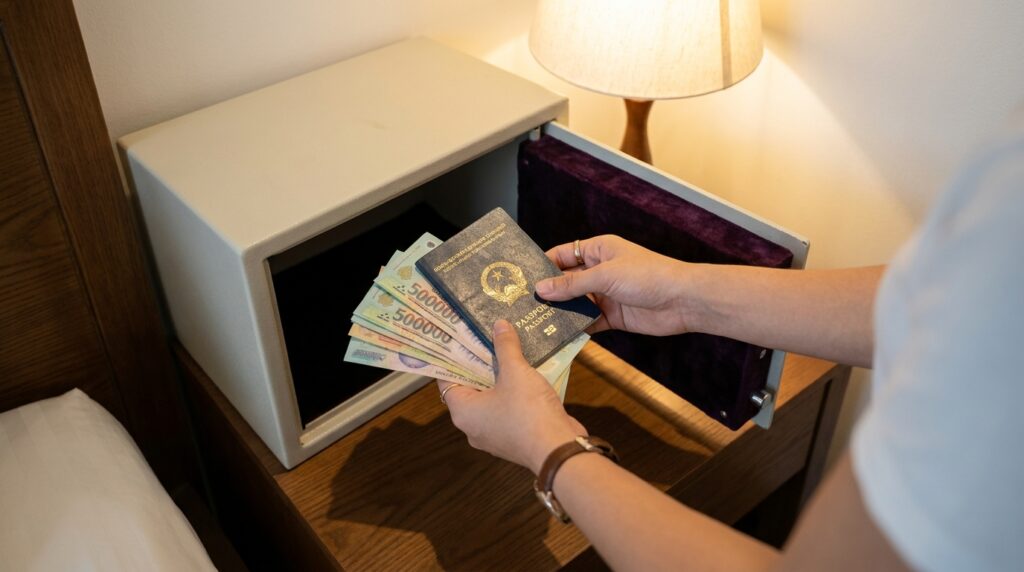
Keep a day’s cash and one card in the wallet you carry, and leave a backup card and some emergency cash somewhere separate. That might be a locked bag in your room, a hidden inner pocket or a different bag from your wallet. If your wallet is lost or stolen, the backup gets you through the day while you sort things out.
Carry only the cash you expect to spend that day, plus a small reserve. Large rolls of notes are hard to keep out of sight when you pay, and they are gone for good if lost, while a card can be frozen in seconds.
Use Cash Machines With Care
Choose cash machines inside banks, shopping centres or airports over ones on a quiet street, especially at night. A machine attached to a bank branch is easier to report if your card gets stuck, and staff may be on hand during opening hours.
Before you put your card in, look at the slot and keypad. If anything looks loose, bulky or added on, use a different machine. Cover the keypad with your other hand while you type your PIN, and put the cash away before you step back from the machine.
Taking out a larger amount less often can reduce per-withdrawal fees, but it means carrying more cash. Balance the two based on how safe you feel in the area and what your bank charges.
Pay in the Local Currency
When a card machine or cash machine abroad offers to charge you in your home currency, choose the local currency instead. The offer is called dynamic currency conversion, and it means the shop’s or machine operator’s payment company does the conversion instead of your own bank. American Express and the Open University’s money pages both say paying in the local currency is usually cheaper, because the conversion offered at the till often has a markup built in.
If a card machine asks whether to pay in your home currency or the local one, choose local. Let your own bank do the conversion.
Watch the screen when a waiter or shop assistant handles the terminal for you. If the amount appears in your home currency, ask them to cancel and run it again in the local currency.
Carry Your Passport Only When You Need It
Decide each day whether you need your passport with you, and lock it away when you do not. Some countries require visitors to carry identification, and some hotels, car rental desks and train services ask to see it, so check the rules for your destination in your government’s travel advice.
When you leave it behind, use the room safe or the hotel’s front-desk safe. When you take it with you, keep it in an inside pocket or a zipped section of your bag, not in a back pocket or an outer pouch.
Carry a photocopy or a photo of the photo page on days the passport stays locked up. It will not replace the real document at a border, but it helps with a police report or an embassy visit if something goes wrong.
Make Yourself a Harder Target in Crowds
Pickpockets look for easy chances, so the goal is to make your valuables slow and awkward to reach. Crowded trains, busy squares, markets and tourist queues are the usual places to be careful.
- Use a bag that closes with a zip and wear it across your body, with the opening facing forward.
- Keep your phone and wallet in front pockets, never in a back pocket.
- Hold your bag on your lap or between your feet at cafe tables, not over the back of the chair.
- Be wary of anyone who bumps into you, spills something on you or pushes a petition or map in front of you.
- Put your phone away between photos instead of holding it loosely at the edge of a platform or road.
Protect Your Phone and Digital Copies
Your phone now holds your boarding passes, bank apps and photos of your documents, so lock it with a PIN or fingerprint and turn on its find-my-device feature before you travel. Both Apple and Android phones include one. Write down your phone’s IMEI number and keep it with your paper copies, because police and insurers may ask for it.
Avoid logging in to banking apps on shared computers in hotels or cafes. On public Wi-Fi, use your own mobile data for anything involving money if you can.
What to Do If Your Cards Are Lost or Stolen
Freeze or cancel the card straight away, either in your banking app or by calling your bank’s emergency number. Most banking apps let you freeze a card with one tap, and you can unfreeze it if it turns up. Then switch to your backup card.
Report the theft to the local police and ask for a written report or reference number. Travel insurers usually want this before they consider a claim, so ask for it even if the police say the item is unlikely to be found.
What to Do If Your Passport Goes Missing
Report a lost or stolen passport to your government and contact your nearest embassy or consulate for a replacement or an emergency travel document. The US State Department says US citizens should report the loss and appear in person at a US embassy or consulate, which can issue an emergency passport if there is no time for a regular one. British nationals can apply for an emergency travel document through the UK government website, which usually covers a single or return journey.
Other countries have their own process, so look it up on your government’s travel pages before you leave and save the address and phone number of your embassy in your destination. Bring your photocopy, a police report if you have one and passport photos if the embassy asks for them.