Twenty minutes a day is enough to learn a new skill if you pick one narrow goal, practise at the same time each day and test yourself instead of only reading or watching. That is about two hours a week, and it fits around most jobs and families. This guide explains how to choose the skill, what a session looks like and how to keep the habit going.
Table Of Content
- How do you choose a skill and a goal small enough to finish?
- What does a 20-minute session look like?
- Why does short and daily beat one long session?
- How do you find the time in a busy day?
- How do you track progress without getting discouraged?
- Which mistakes slow beginners down?
- What if you cannot manage 20 minutes every day?
How do you choose a skill and a goal small enough to finish?
Pick a skill you want to use within the next three months, then write one goal you can check in 30 days. “Learn Spanish” is too wide to check. “Hold a two-minute conversation about my day” is clear, and you will know when you have done it.
- Guitar: play three chords and switch between them without stopping.
- Drawing: draw a mug from life, with the shapes in the right proportion.
- Spreadsheets: build a monthly budget sheet that adds up its own totals.
- Typing: type a full paragraph without looking at the keys.
- Cooking: make one new dish from scratch without reading the recipe twice.
A small goal also tells you what to practise. If the goal is three smooth chord changes, you do not need to learn songs yet.
What does a 20-minute session look like?
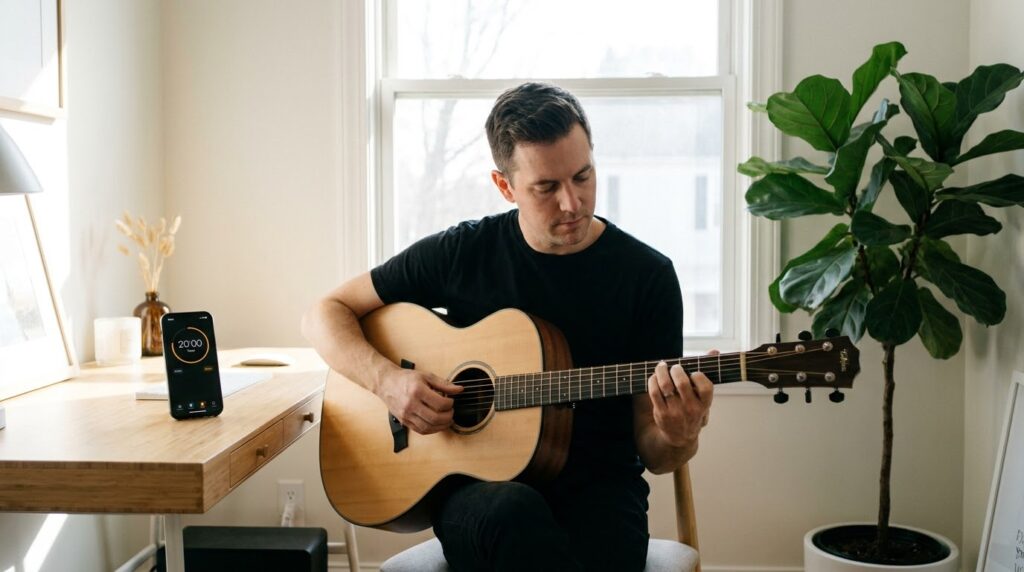
A good session has three parts: a short recall, a focused practice block and a short note. Use a timer so you do not have to watch the clock.
| Minutes | What to do | Why it helps |
|---|---|---|
| 0 to 3 | Recall what you practised yesterday without looking at your notes | Pulling something out of memory is a form of practice testing |
| 3 to 17 | Practise the hardest part of the skill, slowly and with attention | Work on the weak spot, not on what you already do well |
| 17 to 20 | Write two lines: what went wrong and what to try tomorrow | It gives the next session a starting point |
Stay with the hardest part even when it feels slow. Repeating what you can already do feels good, but it does not move you forward.
Why does short and daily beat one long session?
Spreading practice over several days works better than doing it all at once. In a 2013 review of ten learning techniques in the journal Psychological Science in the Public Interest, John Dunlosky and his colleagues gave practice testing and distributed practice the highest utility rating. Their report says both have been shown to help across many kinds of tests and for learners of all ages.
A daily 20-minute plan uses both. The practice is spread across the week, and the recall at the start of each session is practice testing. A single Sunday session of two hours has the same total time, but it gives you only one chance a week to remember what you did before.
How do you find the time in a busy day?
Attach the session to something that already happens every day, such as the first coffee, the lunch break or the half hour before the evening shows. A fixed cue means you do not have to decide when to start.
The University College London habit study followed 96 volunteers who repeated a chosen behaviour in the same setting for 12 weeks. On average the behaviour took 66 days to feel automatic, with a range from 18 to 254 days. The sensible reading is to keep the cue the same and give the habit a couple of months.
- Keep the tools in sight, for example the guitar on a stand or the notebook open on the desk.
- Put the phone in another room for the 20 minutes.
- Use the same place each day, so the room itself becomes a reminder.
- If you miss a day, start again the next day. One missed day did not materially affect habit formation in that study.
How do you track progress without getting discouraged?
Keep a simple log with three columns: the date, the minutes and one line about the session. Once a week, spend five minutes reading the log and comparing it with your 30-day goal. Seeing the pages fill up is often more encouraging than how you feel on any single day.
Progress often feels slow in the second and third week. When a task stalls, make it smaller instead of quitting. If three chord changes feel impossible, practise two chords for a few days, then add the third.
Which mistakes slow beginners down?
- Changing courses all the time. Pick one tutorial series or book and finish it before you judge it.
- Only watching. Watching a lesson feels like learning, but you improve when you try the task yourself.
- Skipping the recall. Opening your notes first is easier, and it also gives you less practice.
- Setting the goal too high. A goal that needs an hour a day will be dropped by the second week.
What if you cannot manage 20 minutes every day?
Do ten minutes on the busy days and keep the same cue. A short session still keeps the habit alive and still gives you the recall step, which is the part that makes the next session easier. On a free weekend you can add one longer block of 40 to 60 minutes, but treat it as a bonus and not as a replacement for the daily sessions.
Choose the skill and write the 30-day goal today, then put the first 20-minute session in tomorrow’s calendar.