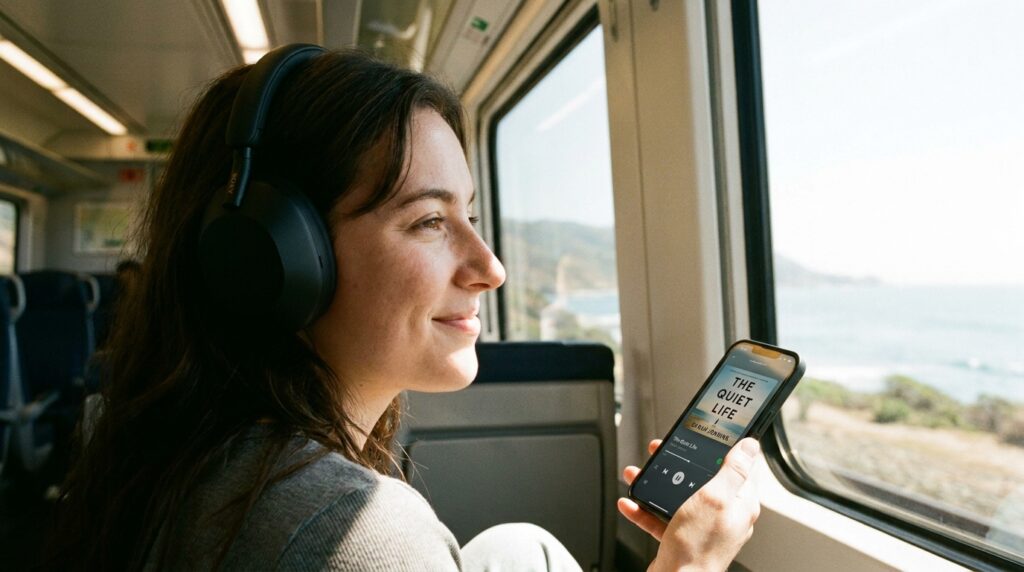
The easiest way to build a reading habit with audiobooks is to tie listening to something you already do every day, such as a commute, a walk or washing up. You don’t need to find new time. You use time that is already there and give it a story.
Table Of Content
With an audiobook you still follow the plot, meet the characters and reach the last page, just through your ears. Here is how to get started and keep going.
Why Audiobooks Make Reading Easier to Fit In
Audiobooks fit into moments when holding a book is impossible, which is why they suit busy days.
You can listen while driving, cooking, folding laundry or waiting in a queue. That turns scattered minutes into steady progress. ACX, the audiobook production service run by Audible, estimates that narrators read about 9,300 words per hour. At that rate, a 90,000-word novel runs to roughly 10 hours. Twenty minutes a day gets you through a book of that length in about a month.
Where to Find Audiobooks, Including Free Ones
You can start without spending anything, thanks to libraries and public domain projects.
The Libby app, made by OverDrive, lets you borrow audiobooks and ebooks from your local library with a library card. It is free to install, with no subscription and no late fees, though what you can borrow depends on your library. Some libraries let you sign up for a card inside the app. Popular titles often have a waiting list, so place holds on a few books at once.
LibriVox offers free recordings of books that are in the public domain, read by volunteers from around the world. It is a good source for classics such as older novels, poetry and history.
Paid services, such as Audible and the audiobook stores built into Apple Books and Google Play Books, sell or rent current titles. Prices and plans vary by country and change often, so check the current offer before you sign up.
Tie Listening to a Habit You Already Have
Linking a new habit to an old one is one of the most reliable ways to make it stick.
The writer James Clear calls this habit stacking and describes it with a simple formula: after (current habit), I will (new habit). For audiobooks, that might be “after I start the car, I will press play” or “after I put my walking shoes on, I will open my audiobook”. The old habit then works as a reminder.
A related idea comes from Katy Milkman, a professor at the Wharton School, who calls it temptation bundling. She allowed herself to listen to gripping audiobooks only while exercising. In a study she ran with colleagues, giving gym-goers access to addictive audiobooks only at the gym raised attendance in the early weeks, although the effect faded after a holiday break. Saving a favourite series for a chore you dislike can work the same way.
Start Small and Be Patient
Ten or fifteen minutes a day is a better start than an ambitious hour you can’t keep up.
A short session is easy to repeat, and repetition is what turns it into a habit. Expect it to take a while. In a study at University College London, researcher Phillippa Lally and colleagues found it took an average of 66 days for a new daily habit to feel automatic, with a wide range from 18 to 254 days depending on the person and the habit. The researchers also noted that missing a single day did not reduce the chance of forming the habit.
Keep your audiobook one tap away. Put the app on your phone’s home screen and download the next few chapters on Wi-Fi, so nothing stands between you and pressing play.
Choose the Right First Book
A first audiobook should be easy to follow and fun to hear, because a hard first book can put you off listening altogether.
These kinds of books usually work well for beginners:
- A novel in a genre you already enjoy reading on paper, such as a mystery or thriller.
- A memoir read by its own author, which often feels like a conversation.
- A book you have read before, so you can relax into the story.
- Short story collections, which suit short trips and give a sense of finishing quickly.
- A popular history or science book written in a chatty, story-led style.
Books that rely on charts, maps or long lists are better on paper. Always play the free sample first. The narrator’s voice makes a huge difference, and one you find irritating will spoil even a great book.
Use the Playback Tools
Audiobook apps have settings that make listening easier, and a few minutes learning them pays off.
Playback speed is the most useful. Libby, for example, lets you choose a preset or fine-tune the speed from 0.6 to 3 times normal. Try small changes rather than jumping straight to double speed, and slow down again for books with lots of dialogue or unfamiliar names.
A sleep timer stops playback at the end of a chapter or after a set number of minutes, which helps if you listen in bed. Bookmarks let you mark a passage you want to return to. If your mind drifts, the skip-back button takes you back a few seconds so you can pick up the thread.
Keep Track and Stay Motivated
Seeing your progress encourages you to keep going, especially in the first couple of months.
Write the books you finish in a notebook, or keep a list in a notes app. Some people enjoy rating each one or writing a single line about what they liked. Talking about a book with a friend or joining a library book group also adds a reason to finish.
If a book isn’t working after a few hours, return it and start another. You don’t have to finish every book you begin, and swapping a dull one for a gripping one makes it far easier to keep listening each day.
Listen at a comfortable volume, take breaks from headphones, and stay aware of traffic when you listen outdoors, especially when walking or cycling near roads.