The best first board game for a family is one the youngest player can follow and that finishes before anyone gets restless. Rules you can teach in about ten minutes help too. Get those basics right and the theme matters far less than you might think.
Table Of Content
Board games have changed a lot in recent decades. Alongside the old classics, there are hundreds of modern family games designed for short, friendly sessions where nobody is knocked out early. Here is how to pick one your family will want to play again.
Start With Who Will Play
Count your usual players and note the youngest, because those two facts rule out more games than anything else.
Every box lists a player count, a suggested age and a typical playing time. Treat the player count as a firm limit and the age as a guide. A confident seven-year-old who loves puzzles may manage a game marked 8+, while a tired adult may not enjoy a game marked 12+ at the end of a long day.
Think about the group’s mood too. Some families love quiet strategy, others want laughter and noise. If one person hates losing, a game where everyone wins or loses together, called a cooperative game, can keep the evening friendly.
Check the Playing Time and the Rules
For a first game, aim for something that plays in 15 to 45 minutes and has a rulebook you can get through in one sitting.
Short games have a big advantage: if the first round goes badly, you can play again straight away with everyone now knowing the rules. A long game that confuses people halfway through often ends up back on the shelf.
Look for games where each turn is simple, such as drawing a card and placing a tile, or matching a picture. Games that let people play at the same time, rather than waiting through long turns, also suit restless children.
Use Awards as a Shortcut
Award lists are a quick way to find well-tested family games, and the best known is Germany’s Spiel des Jahres (Game of the Year).
The prize was created in 1978 to reward family-friendly game design. Winners tend to be easy to teach, quick to play and fun across ages. There is a separate children’s prize, the Kinderspiel des Jahres, for games aimed at younger players, which is handy if your children are under eight.
Good Starter Games to Look For
These well-known games all have simple rules and short to medium playing times, and most have won the Spiel des Jahres. Player counts and times come from the published game details, so check the box of the edition you buy.
| Game | Players | Typical time | Why it works for families |
|---|---|---|---|
| Kingdomino | 2 to 4 | 15 to 20 minutes | Domino-style tile laying; won the Spiel des Jahres in 2017 |
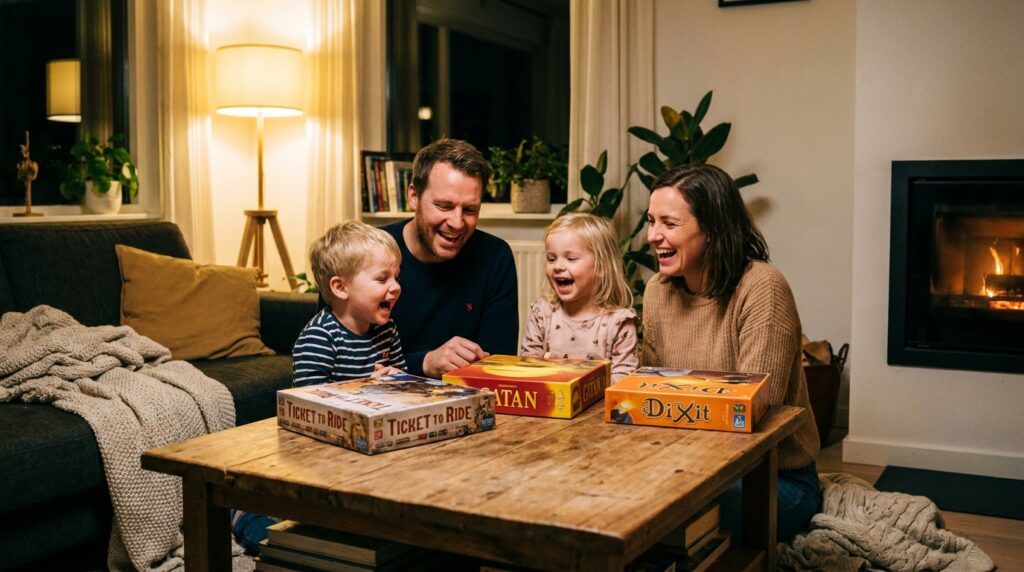
| Ticket to Ride | 2 to 5 (varies by edition) | 30 to 60 minutes | Collect cards to claim train routes; 2004 winner; First Journey editions aimed at ages 6+ |
| Carcassonne | 2 to 5 | 30 minutes or more | Build a map together tile by tile; 2001 winner |
| Dixit | 3 to 6 | About 30 minutes | Guess the story behind dreamlike pictures; 2010 winner |
| Codenames | 4 to 8 or more | 15 to 30 minutes | Team word-guessing game; 2016 winner; best with older children and adults |
| Dobble (Spot It!) | 2 to 8 | About 15 minutes | Fast matching game in a small tin |
If your family is new to modern games, Kingdomino or Dobble make a gentle start. Ticket to Ride and Carcassonne are a good next step once everyone is comfortable with taking turns and planning ahead.
Match the Game to Your Family’s Style
Different families enjoy very different things, so think about what already makes yours laugh.
Families who like puzzles and planning often enjoy tile-laying games such as Carcassonne. Chatty, creative groups tend to like storytelling and guessing games such as Dixit. If your house is loud and competitive, a fast reaction game like Dobble suits the mood. Word lovers will usually take to Codenames, as long as the youngest players read well.
Watching a short video of a game being played, or reading a few family reviews, shows you more about how it feels than the box ever will.
Make the First Game Night Go Well
How you teach the game matters almost as much as which game you pick.
Read the rules yourself before game night and play a practice turn alone. Teaching from memory is far easier than reading the rulebook out loud to a waiting table.
Explain how to win first, then what happens on a turn. Start playing quickly and explain the smaller rules as they come up. For the first round, let children ask for help and keep the score loosely.
Keep the first session short, and stop while people are still enjoying themselves. Ending on a high makes everyone keen to play again.
Build a Small Collection Over Time
Once one game is a hit, add others slowly, so each one gets enough play to become a favourite.
A quick game for weeknights and a longer one for weekends make a good pair, and a party game earns its place once relatives start visiting. Libraries, toy libraries and board game cafés in many towns let you try games before you buy, which saves money on ones that don’t suit your family.
Store the pieces in small bags inside each box and keep a pencil with the score pad, so the next game night can start the moment the table is cleared.